Multi-Show Calendars: How We Design for the Year Ahead
When you’re exhibiting once or twice a year, it’s easy to treat each event as a standalone project. You brief it, design it, build it, deliver it, and move on.
Most brands don’t lose money on exhibitions because of bad design. They lose it because every show is planned in isolation.
That approach starts to fall apart when you’re working across a multi-show calendar.
Multiple shows bring a different level of complexity. Different venues, different audiences, different stand sizes, and often different internal priorities depending on where the business is at. What worked well at one event doesn’t always translate cleanly to the next.
This is where most brands start to feel the friction. Designs get rebuilt too often, messaging shifts too quickly, and the internal workload grows with every additional event.
The brands that get consistent results don’t approach exhibitions like this. They plan the year properly, before any design work begins.
At Grand Stand Events, that planning phase is where most of the value is created. It’s not the most visible part of the process, but it’s the part that determines whether a stand works once or continues to work across an entire year.
This approach is most relevant for marketing teams managing multiple events across the year, where consistency, cost control, and internal efficiency start to matter.
Start With the Calendar, Not the Design
The natural instinct is to start with the stand. What it should look like, what it should include, how it should feel.
That’s not wrong, it’s just premature.
If you’re committing to multiple events, the better starting point is your event calendar. Every show you plan to attend should be mapped out early, even if some details are still being confirmed.
Once everything is laid out, you can start to see how each event fits into the bigger picture. Some will carry more weight than others. Some will be focused on visibility, while others are more about conversations and relationships. Some will justify a larger footprint, others won’t.
Without this step, it’s very easy to treat every event the same. That usually leads to over-investing in some areas and underperforming in others.
With a clear calendar, you can start to prioritise properly.

How to Plan a Multi-Show Calendar
Before any design work starts, you should be able to answer five things clearly:
- • What events are we committing to across the year?
- • What role does each event play, whether that is visibility, lead generation, or relationship building?
- • What stand sizes or formats are required for each?
- • What elements should be reused and what should be updated?
- • How will logistics, including transport, storage, and install timing, be managed between shows?
This doesn’t need to be complex. But it does need to be defined.
Without it, every event becomes reactive.
Each Event Needs a Clear Role
Not every show should be expected to deliver the same outcome.
A large industry exhibition might be about brand presence and scale. You’re there to be seen, to hold your position, and to make an impression.
A more targeted conference might be about quality conversations. You don’t need as much space, but you do need the right environment for meaningful engagement.
A regional event might simply be about showing up consistently and being accessible to a different segment of your market.
When you define the role of each event early, it becomes much easier to make decisions later. You’re not trying to force every stand to do everything. You’re designing for purpose.
That clarity flows through into layout, messaging, and how the team uses the space.
Designing for Flexibility From the Start
One of the biggest mistakes in multi-show planning is designing a stand that only works in one format.
It might look great at the first event, but as soon as the footprint changes or the orientation shifts, it becomes harder to adapt. That’s when you see rushed adjustments, compromised layouts, or full rebuilds that weren’t originally planned.
A better approach is to design with flexibility built in.
This doesn’t mean creating something generic. It means thinking carefully about how the stand will behave across different environments. Can it scale up and down without losing its structure? Can key elements be repositioned without affecting the overall look? Can branding be updated without replacing major components?
These are practical considerations, not theoretical ones. When they’re addressed early, the stand becomes far easier to manage across multiple events.
Maintaining Consistency Without Becoming Repetitive
Consistency matters. Your stand should feel recognisable wherever it appears.
At the same time, repeating the exact same setup at every event can work against you. Visitors who see your brand multiple times throughout the year need a reason to engage again.
The way to manage this is by separating what stays consistent from what changes.
The structure, core design language, and key brand elements should remain stable. These are the foundations that create recognition.
Messaging, product focus, and content should be more flexible. These can be updated to suit the specific audience and objective of each event.
This approach allows you to maintain a strong presence while still keeping things relevant.
Logistics Need to Be Considered Early
Logistics are often treated as something to solve later. Across a single event, that can work. Across multiple events, it creates unnecessary pressure.
Transport, storage, and installation timelines all need to be considered as part of the initial planning process. Where the stand sits between events, how quickly it needs to be turned around, and how it moves from one venue to the next all impact how the system should be designed.
Ignoring this early usually leads to inefficiencies later. More handling, higher costs, and tighter install windows.
When logistics are planned alongside design, the entire process becomes more predictable. Installations run cleaner, pack-downs are more efficient, and the team spends less time solving avoidable problems.
Across a full calendar, this often translates to reduced install time, fewer last-minute adjustments, and better use of internal resources.
Cost Efficiency Comes From Reuse, Not Reduction
There’s often a focus on reducing costs per event. In a multi-show strategy, the more effective approach is to think about how costs are used across the year.
Designing and building a new stand for every event isn’t sustainable. It increases production costs and creates unnecessary repetition in the process.
A better approach is to invest in a system that can be reused and adapted.
This doesn’t eliminate costs, but it changes where they’re directed. Instead of rebuilding each time, you’re refining what already exists. Updating messaging, improving engagement elements, and making incremental improvements based on what you’ve learned.
Over a full calendar, this is where efficiency is created.
Where Multi-Show Strategies Usually Break Down
Even with good intent, most multi-show strategies fall over in similar ways:
- • Different stakeholders driving each event
- • Late approvals impacting production timelines
- • No clear reuse plan between shows
- • Logistics handled separately each time
None of these are major issues on their own. But across a full year, they compound quickly.
Planning ahead is what prevents them.
QB Foods
QB Foods’ 2025 exhibition program is a clear example of what happens when you plan across multiple events, not just one. Instead of treating each show as a separate build, the stand was designed as a flexible system that could be reused and adapted across two major exhibitions.
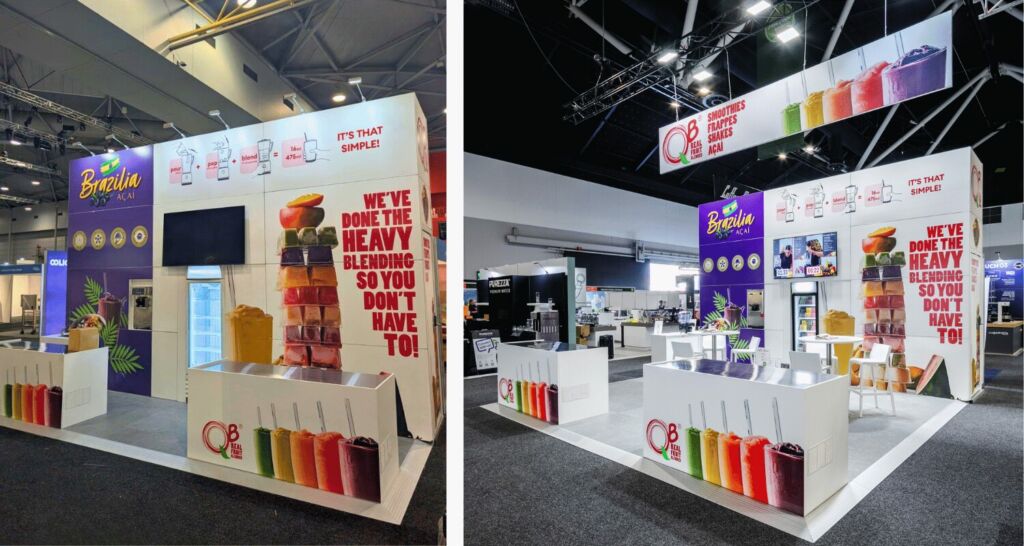
| Element | Fine Food Australia 2025 (ICC Sydney) | Food & Hospitality Expo 2025 (Brisbane) |
|---|---|---|
| Stand Size | 6m x 6m peninsula | 6m x 3m peninsula |
| Overall Approach | Full-scale build for high traffic | Condensed version of existing system |
| Structure | Full framed walling system | Reused and reconfigured frames |
| Signage | Custom printed panels throughout | Existing panels reused where possible |
| Counters & Displays | Integrated product display zones | Repositioned to suit smaller footprint |
| Equipment Zones | Dedicated areas for freezers, soft serve, prep | Retained but tightened into compact layout |
| AV | 65” screen with full integration | Screen retained and reinstalled |
| Flooring | Eco flooring with vinyl finish | Reduced flooring to match footprint |
| Flexibility | Designed with reuse in mind | Adapted without full rebuild |
| Outcome | High-impact flagship presence | Efficient, consistent second execution |
| Key Advantage | Elements produced once with future use planned | Reduced cost, faster install, consistent brand |
The result was a consistent brand presence across both shows, with reduced production costs, faster install times, and far less waste. You can see this directly in the project, where existing signage and custom items from the first event were carried through into the second, rather than being rebuilt.
This is what a considered multi-show strategy looks like. Not just a good stand, but a system that works harder across the full event calendar.
Sage
Sage’s 2026 exhibition program is a strong example of designing once and carrying that thinking across multiple events.
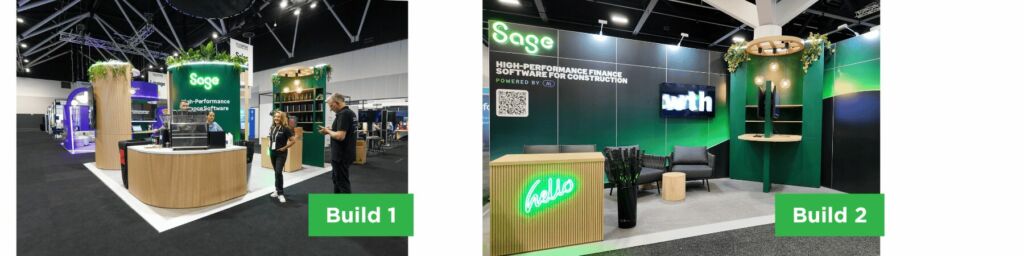
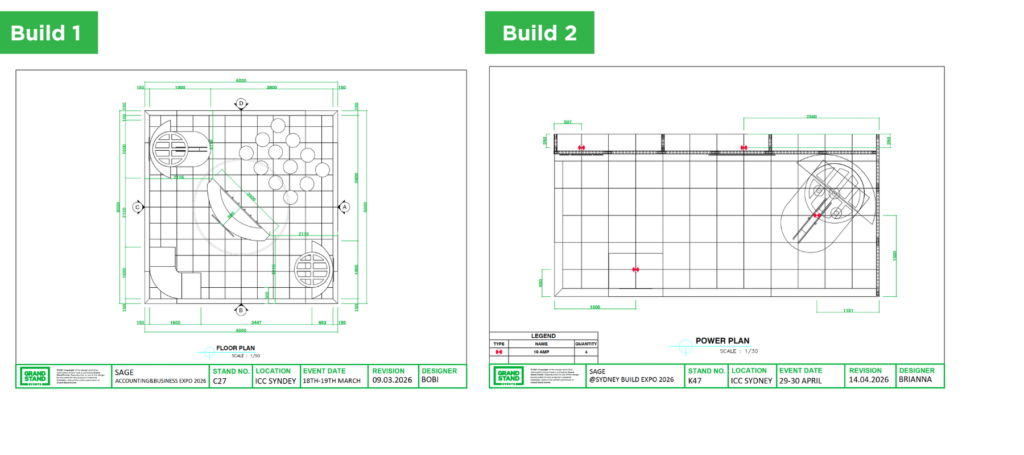
| Element | Accounting & Business Expo 2026 (ICC Sydney) | Sydney Build Expo 2026 (ICC Sydney) |
|---|---|---|
| Stand Size | 6m x 6m island | 6m x 3m inline |
| Overall Approach | High-impact, immersive flagship build | Condensed and reconfigured version |
| Layout | Open plan with multiple engagement zones | Linear layout with tighter zoning |
| Hero Feature | Large curved feature wall with central tower | Curved unit retained and repositioned |
| Custom Elements | Multiple custom-built units across the stand | Core custom units reused |
| Counters | Full coffee counter for interaction | Reception/counter retained and adapted |
| AV Integration | Multiple screens and integrated content zones | AV setup reused in compact format |
| Lighting | Overhead lighting and feature integration | Existing lighting reused and repositioned |
| Walling & Signage | Full custom cladding and messaging | Adjusted to suit inline configuration |
| Engagement Style | Mix of demos, conversations, and product zones | Focused, efficient interaction points |
| Key Advantage | Built as a complete experience | Reused system with reduced rebuild cost |
What’s important here is what didn’t change. Core custom elements, structural thinking, and brand presence remained consistent across both shows. The second build wasn’t a compromise. It was a more efficient version of the first. You can see this directly in the project scope, where existing custom units and reception elements were reused rather than rebuilt.
The result was a cohesive presence across both events, with reduced production costs, faster installs, and a stand system that worked across two very different footprints. This is exactly how a multi-show strategy should perform in practice.
Qantas
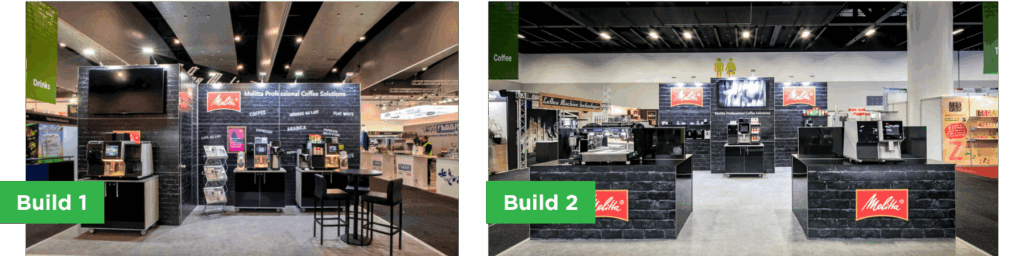
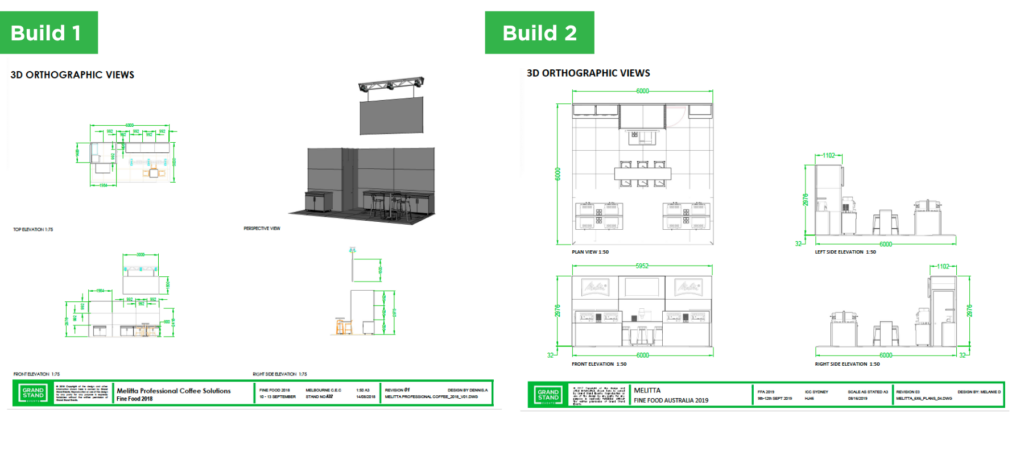
Across 2018 to 2020, Qantas leveraged a modular exhibition build that could be deployed nationally, reconfigured between shows, and incrementally improved over time. The same core structure supported multiple cities, different layouts, and evolving brand requirements without starting from scratch.
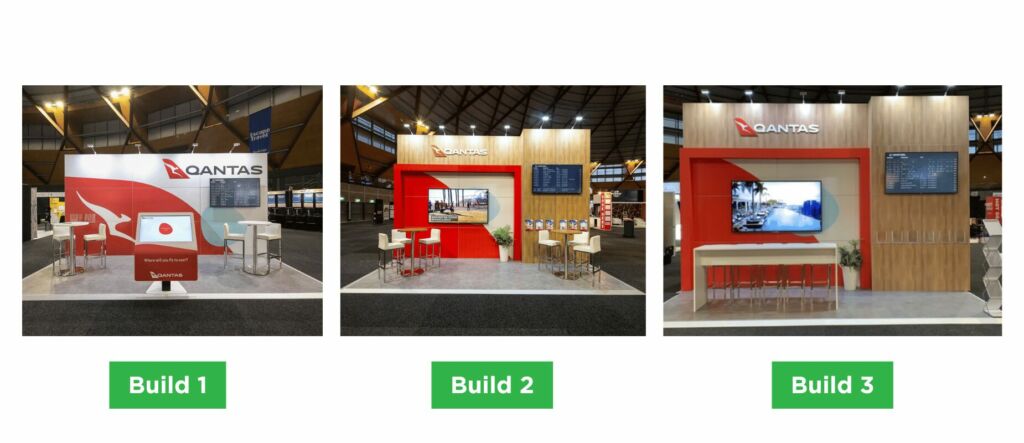
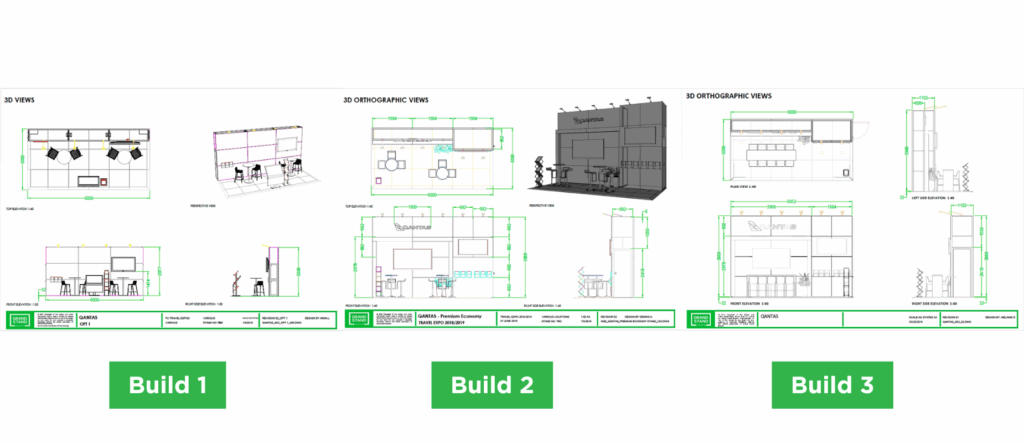
| Element | Travel Expos 2018 (Economy / Premium) | Flight Centre 2019 Roadshows | Flight Centre 2020 |
|---|---|---|---|
| Core Objective | Scalable national expo rollout | Repeatable system across cities | Refined, higher-spec rebuild |
| Stand Format | 6m x 3m inline modular builds | Same system deployed across multiple locations | 6m x 3m evolved footprint |
| Rollout Strategy | Multi-city expo circuit (5–7 cities per round) | Rebuild and redeploy model across states | Consolidated rebuild with upgraded components |
| Design System | Two kit types: Economy + Premium variants | Same kits reused and rotated | Existing system refined rather than replaced |
| Structure | AMES frame system with modular panel inserts | Core framework retained and reused | Full rebuild using existing system architecture |
| Branding | Printed PVC panels, large-format graphics | Panels refreshed and swapped as needed | Updated finishes and improved detailing |
| AV Integration | Screens, kiosks, brochure displays | AV components reused across events | Integrated into refined layout |
| Flooring | Raised flooring with vinyl finish | Reused across locations | Rebuilt and reset per deployment |
| Functionality | Storage zones, brochure walls, meeting areas | Maintained across all shows | More resolved zoning and flow |
| Logistics Model | Freight + install per city | National transport and rebuild cycle | Large-scale rebuild and freight program |
| Key Advantage | Built once, used across full expo calendar | Reduced cost per event through reuse | Higher production value without full redesign |
| Commercial Outcome | Enabled national presence efficiently | Significant cost savings across rollout | Improved finish with retained efficiencies |
The same core structure supported multiple cities, multiple layouts, and two distinct product tiers, Economy and Premium. Instead of rebuilding from scratch each time, Qantas invested in a framework that could be transported, reconfigured, and upgraded over time.
That approach does two things. It reduces cost per show, and it increases consistency across the brand experience.
Aligning Exhibitions With Broader Marketing Activity
Exhibitions shouldn’t sit outside your marketing strategy. When they do, they often feel disconnected from everything else the brand is doing.
If you’re planning a multi-show calendar, this gives you the opportunity to align your activities more closely.
Product launches can be timed around key events, campaign messaging can carry through into the physical space, and content created for exhibitions can be reused across other channels.
When everything is aligned, exhibitions become more than standalone events. They become part of a larger, more cohesive strategy.
Preparing the Team to Use the Space Properly
Even the best-designed stand relies on the people using it.
If the team doesn’t understand how the space is intended to function, performance will suffer. Conversations won’t happen where they should, engagement will feel inconsistent, and the overall experience will be less effective.
With a multi-show approach, there’s an opportunity to build familiarity. The team becomes more comfortable with the layout, more confident in how to use it, and more consistent in how they engage with visitors.
Using Early Events to Improve Later Ones
One of the advantages of working across a full calendar is the ability to refine as you go.
The first event is rarely perfect, and it doesn’t need to be. What matters is what you learn from it.
Those insights should inform what happens next.
Small adjustments between events can have a noticeable impact by the end of the year. The stand becomes more efficient, the messaging sharper, and the overall experience more aligned with your objectives.
Planning Ahead Changes the Outcome
There’s a clear difference between brands that plan their exhibition calendar properly and those that approach each event as it comes.
Planning ahead doesn’t remove the complexity of exhibitions, but it does give you control over how that complexity is managed.
You know what’s coming, you understand what each event needs to achieve, and you’re working from a structured plan rather than starting from scratch every time.
If you’re currently mapping out multiple events and aren’t sure how to structure them, this is the stage where we usually step in. Getting this right early removes a lot of pressure later.
Now is the time to get ahead.

BRANDS WE’VE MADE STAND OUT